Views: 34
In 2016, Katherine Power posted a five-minute GRWM video from her bathroom on Instagram. The likes poured in. “I had hacked together a routine using a concealer stick and an old MAC lip tint as blush, and the response was overwhelming,” says the Merit founder. That video would inadvertently lay the foundation for a new kind of beauty brand. Minimalist makeup was a bold concept at the time. This was the era of 12-step skincare routines, 20-shade eyeshadow palettes, extreme contouring and baking. “Beauty routines were maximalist and time-consuming, and I was doing the exact opposite,” recalls Power, the co-founder of Who What Wear, who later founded Avaline wine with Cameron Diaz and the skincare line Versed. “That was the spark for Merit.” A decade after that video, and five years after launching, Merit is the little minimalist beauty brand that could. The numbers back up the less-is-more philosophy: Merit generated roughly $140 million in revenue in 2024, has expanded to 10 countries and still keeps its product lineup tightly edited at just 19 SKUs.
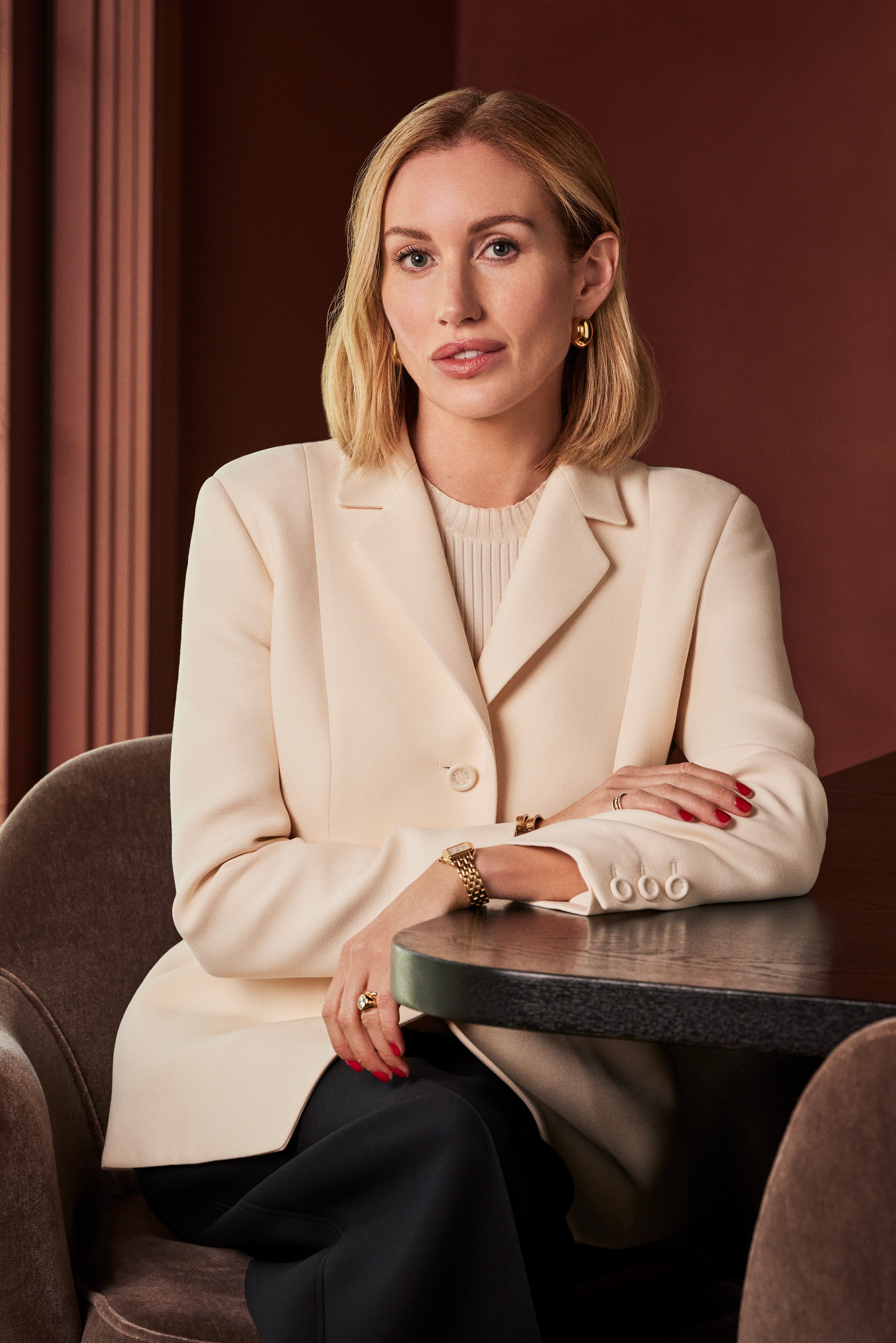
Katherine Power courtesy of Merit
“We wanted to question everything that was conventional, everything that beauty brands were doing, and come at it from a very different direction,” says Aila Morin, Merit’s chief marketing officer, who was previously the director of marketing at Mejuri. The Huntsville, Ont., native channelled her early experience working as a cosmetician at Shoppers Drug Mart throughout high school and university when she joined the Merit team in 2020. “People weren’t coming in asking ‘How do I get a cut crease?’ It was ‘Do I need a brown or a black mascara How do I use eyeliner? Can you shade match me?’” recalls Morin, who now lives in L.A. “An entire industry is built to serve the needs of women, and 80 percent of the consumer demographic don’t feel they know how to use the products. It makes no sense.” From day one, Merit set out to fix that, creating “clean” products with non-irritating ingredients in intuitive formats—a foundation stick you hold like a ballpoint pen to apply, a bronzing cream inspired by Men’s Speed Stick—products that enhance your natural beauty and take seconds to blend in. Once considered Glossier for grown-ups, Power describes it in 2026 as “a brand built for people who want luxury, simplicity and ease in their beauty routine.” Along with efficacious products came core principles: Merit has long shied away from celebrity spokespeople (until recently, when Christina Ricci fronted the launch of its Solo Shadows); no hero product; thoughtful, paced launches; and marketing that features models who mirror its millennial shopper.
What began as a teenage dream and a five-minute GRWM is now the blueprint for beauty minimalism.
Forget manufactured virality—Merit’s marketing strategy thrives on fearless, rule-breaking simplicity. Case in point: Merit wiped its Instagram when it launched skincare in 2022 and again when it debuted its Solo Shadow Sheens last October— moves that would have left those who pray to the algorithm gods shaking. “We have had the same mission for five years: Simplify what it takes to get ready,” says Morin. “As long as we stay true to that… It’s given us an incredible capacity to scale, because we have trust.” To this day, Morin reviews every DM the brand receives and, wherever possible, incorporates feedback into products. Take Merit’s Minimalist Perfecting Complexion Stick. When it launched in 2021, Merit received complaints that customers were going through it too fast. The company decided to double its size but keep the same price. Launching its fragrance, Retrospect, wasn’t an industry first, but it was a bold one for a modern makeup brand. When Merit launched, colour companies weren’t typically expanding into scent, says Morin. “It was a bold move for us as a three-year-old makeup brand, but it ladders back to our ambition to be a tri-axe brand—we make your everyday concealer and mascara but also your moisturizer and your fragrance.” The launch put Merit at the forefront of a shift that’s since become ubiquitous. Fast-forward to 2026 and nearly every skincare, hair-care and makeup brand has a scent. But once again, Merit flipped the switch, creating a clean extrait de parfum with a high concentration of fragrance oil, allowing it to melt into the skin. “Fragrance today has become either literal and linear or celebrity-led, and we wanted to build a world that was product and quality-led,” says Morin.

Aila Morin courtesy of Merit
“It really is a case study on how to build a brand,” says Helen Steed, whose team, the L.A.-based Steed+Friends, partnered with Merit on brand identity, positioning and packaging in 2020. Steed, who previously worked as creative director at Bumble and Bumble and Glossier and has worked with brands like Rhode and Supergoop!, recalls being impressed by Power’s vision from the start. “Merit just knows its customer so well—how to reach her, how to talk to her. Its focus has always been really sharp. It doesn’t chase after every shiny meme.” Any Merit fan will notice that, unlike with traditional beauty brands, Merit products are packaged in different, complementary colours—items that feel like heirlooms you want sitting out on your vanity. That’s deliberate, says Steed: “We wanted it to feel good in your hands. The feeling of fewer, but better quality, items. Like that perfect sweater you’re going to wear year in, year out, or that beautiful watch. That feeling of less is more.” Merit’s luxe signature pouch, which first-time customers receive upon purchase, drives home that feeling of collectability. The brand has partnered with the likes of Brandon Maxwell and Proenza Schouler on these bags, which you could easily carry on a night out on the town. Of course, the inevitable question when you’re the founder of a successful beauty brand—especially in light of the beauty musical chairs of 2025—is: To sell or not to sell? Morin doesn’t even blink before saying the nicest “no” I’ve ever heard. “It’s the highest compliment, but it’s also not why we do what we do,” she says. “We’re honestly focused on the day-to-day and continuing to build. We do it because we love it. This has been my passion since I was a 14-year-old working at Shoppers Drug Mart.” What began as a teenage dream and a five-minute GRWM is now the blueprint for beauty minimalism. [content_module id=”1″] This article first appeared in FASHION’s March 2026 issue. Find out more here. Continue Reading