Views: 73
In the world of perfume, the vessel has often been just as precious as the scent it holds. Cases in point: Salvador Dalí’s surrealist bottle for Le Roy Soleil in 1946 and Elsa Schiaparelli’s sculptural Shocking flacon, shaped like a woman’s torso, in 1937. These creations weren’t mere packaging; they were works of art in their own right—museum-worthy objects that blurred the line between beauty and design. Today, that legacy lives on as luxury fragrance houses increasingly collaborate with artists, glass-makers and craftspeople to release hyper-limited editions that collectors covet as much for the vessel as the juice inside. As Ann Caroline Prazan, Guerlain’s artistic director of brand culture and heritage, explains, their clients appreciate these exceptional pieces as collectible objects: “Since 1828, Guerlain has collaborated with the greatest artists of their time—to create some of the most beautiful perfume bottles in the world.” And while the fragrances themselves may fade, these bottles endure.
Bottles as Icons
Fragrance houses know that a great bottle can outlive the scent inside, but few understand this better than Guerlain. “Pierre-François-Pascal Guerlain, the founder, understood from the very beginning that the bottle is just as important as the fragrance itself,” says Prazan. In 1853, the French beauty house created Eau de Cologne Impériale for Empress Eugénie de Montijo’s wedding to Napoleon III. Its flacon, adorned with 69 gilded bees (an emblem of the Empire), became known as the Bee Bottle. “For over 170 years, it has been crafted in the same way and by the same factory,” says Prazan. “It remains the oldest perfume bottle in the world still in production today.” 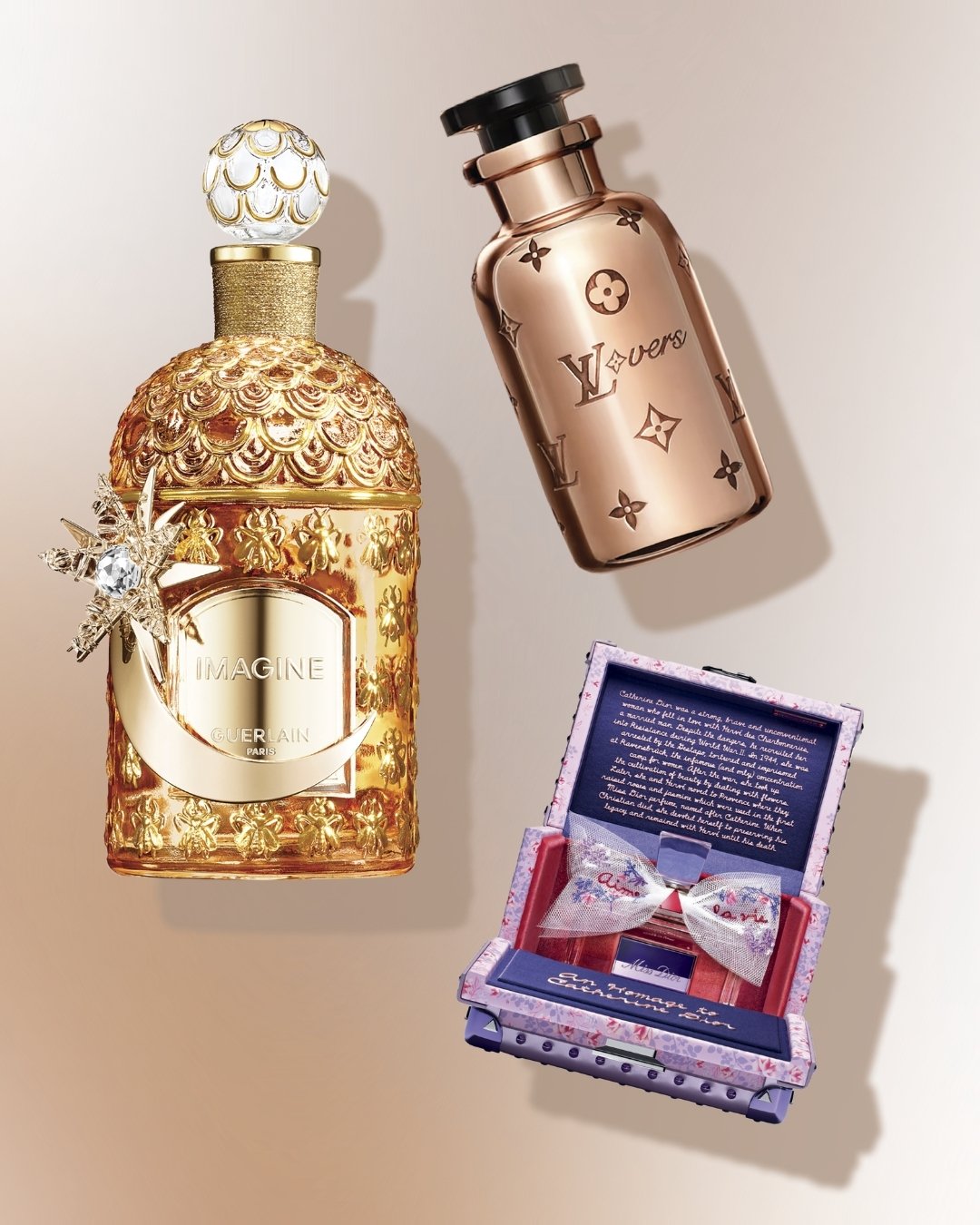 When it comes to the Bee Bottle, Guerlain often treats it as a living canvas. For its 2025 holiday Exceptional Rendezvous, the house unveiled Imagine by French artist and sculptor Géraldine Gonzalez. Known for her whimsical, baroque-inspired creations that play with light, Gonzalez adorned the iconic flacon with a gleaming metallic crescent moon and star delicately embellished with sparkling glass beads. The result is a fantastical objet d’art, a blend of sculpture and fragrance vessel, with just 3,665 produced worldwide, costing $1,280 a pop. “The artists undeniably influence the fragrance’s perception, imbuing the object with their poetry or message,” she says, adding that it transforms the piece into something emotionally resonant for the client. Dior shares this instinct to elevate its bottles into cultural artifacts. Its recent collaboration with American feminist artist Judy Chicago transformed Miss Dior, which launched in 1947, into a sculptural manifesto. The case, a tribute to Christian Dior’s sister Catherine (a member of the French Resistance), reframes the fragrance as a story of courage and creativity. Eager to cement its icon status, Louis Vuitton marked the first birthday of its LV Lovers cologne with the release of a copper-embellished edition earlier this year, etched with its monogram.
The Collector’s Lens
In perfumery’s upper echelon, certain bottles transcend function, produced in tiny numbers and collected as much for their artistry as their scent. And few milestones warrant a tribute quite like a 100th birthday. In 1925, Jacques Guerlain launched Shalimar, the world’s first amber-based fragrance, housed in a fan-stoppered bottle inspired by the Shalimar Garden. For its centennial, the house turned to Franco-Brazilian artist Janaïna Milheiro to drape the 1.65-litre flacon in flamboyant feathers and flowers, an ode to Frida Kahlo’s Casa Azul. Only 66 were produced worldwide, each retailing for $32,400. “It creates a beautiful dialogue between high perfumery and artisanal excellence, reaffirming Shalimar’s place as an icon where audacity truly meets heritage,” says Prazan. 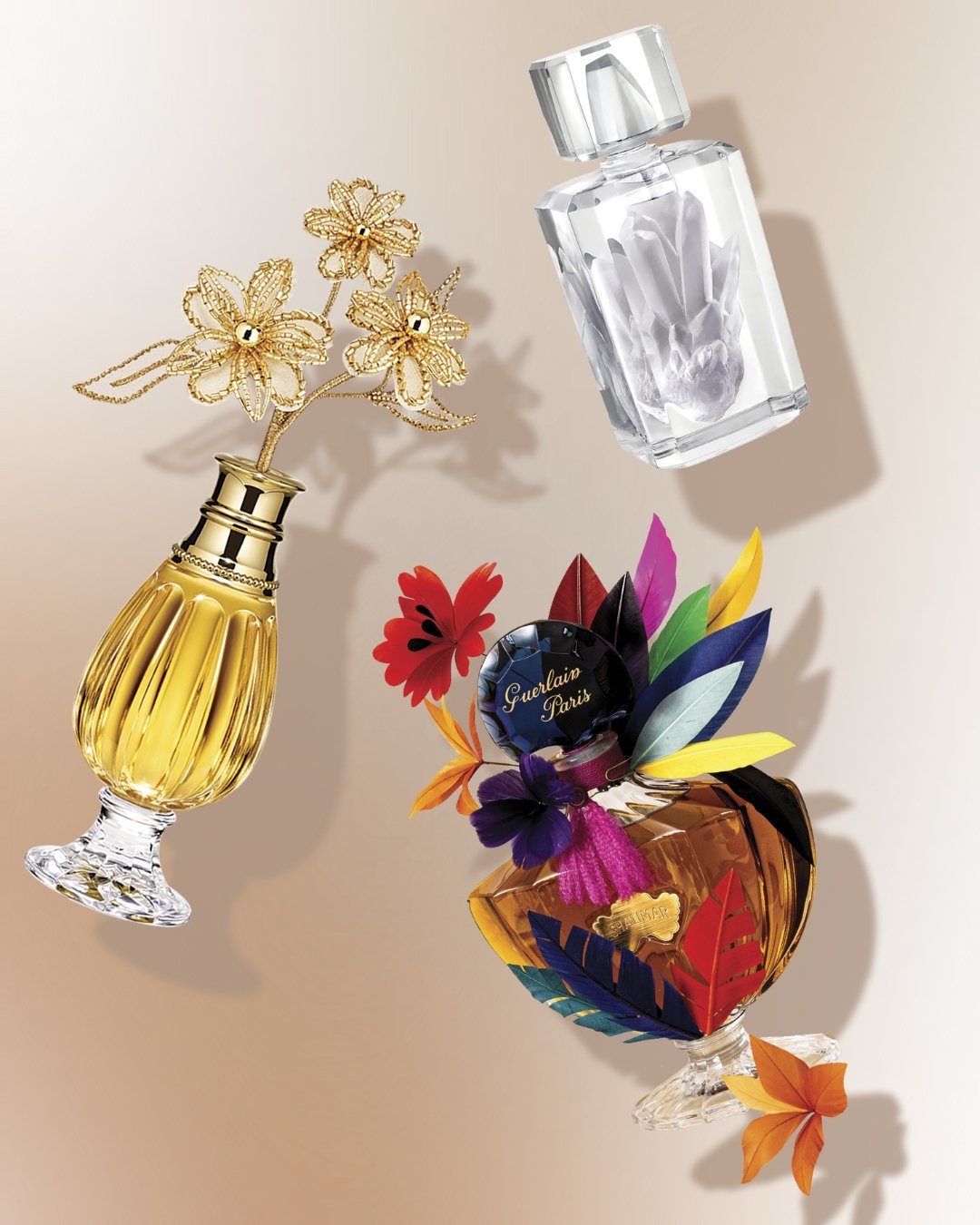 Dior takes a similarly elevated approach with its Les Récoltes Majeures series—a trio of “exceptional pieces” dedicated to Christian Dior’s cornerstone flowers: jasmine, lily of the valley and rose. Each year, only 200 amphorae are released, their caps crowned with intricate designs by the storied Maison Vermont embroidery house. Under the direction of perfume-creation maestro Francis Kurkdjian, the fragrances themselves become vessels of artistry, from the tender Le Muguet in spring to the luminous Le Jasmin in autumn. Together, they elevate perfume into objects worthy of a gallery—think couture for the vanity. Lalique, the legendary French glass-maker who helped define art nouveau and art deco, recently partnered with Brioni on a crystal edition of Dualité, a run of just 18 flacons priced at a staggering $62,600 each. Inside the 340-millilitre crystal flacon is a luminous fragrance of crisp green apple, rich iris and warm cedarwood; this one is paired with an additional 80-millilitre bottle to “preserve the integrity” of the masterpiece. But like a sculpture in a gallery, only a lucky [read “rich”] handful will ever bring one home. [content_module id=”1″] This article first appeared in FASHION’s November 2025 issue. Find out more here. Continue Reading