
Views: 177
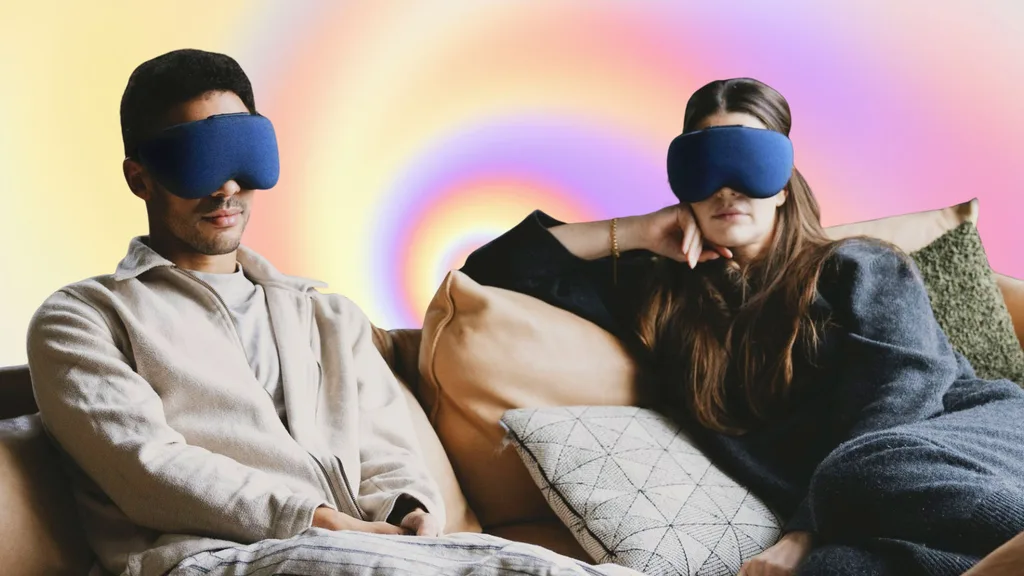
If you’ve spent any time in therapy, on wellness TikTok, or adjacent to someone who has, you’ve probably encountered the word ‘neuroplasticity’ — the brain’s ability to rewire itself in response to new information, and the theoretical backbone of everything from EMDR to microdosing retreats to the new Lumenate Nova, a strobing eye mask that wants to do all three before lunch.
Therapies that hinge on neuroplasticity offer something different: a way to change your brain, form new beliefs, and shift your feelings about what has happened to you, rather than endlessly rehashing it. The increased popularity has coincided with a growing suspicion that endlessly analysing our childhoods, love languages, and DSM diagnoses can increase self-awareness, but doesn’t reliably result in greater happiness or behavioural change. Essentially, you’re left with a nuanced appreciation for how dysfunctional you are and occasionally an increased resentment towards your parents, with no tools to change the dysfunction.


Well-known therapies in this space include hypnotherapy, EMDR, and psychedelic-assisted therapy for treatment-resistant depression and PTSD. But it’s also the underpinning logic for half of TikTok — manifestation, energy cleansing, and other practices your most enlightened friends will not shut up about. They all work by harnessing the brain’s ability to change its connections and behaviour in response to new information, usually via some form of distraction: the hypnotist’s watch, the tappers in EMDR, binaural beats or, in this instance, strobe lights.
I became extremely interested in all of this a few years ago after finally becoming exasperated with my body’s ability to generate extreme stress and my mind’s ability to make poor decisions based on it. I abandoned traditional therapy for MKUltra-ing myself with self-hypnosis recordings and meditation strategies and found my mental health significantly improved.
So when I was emailed about the Lumenate Nova, a “consciousness-shifting light mask” created by former mechanical engineers Jay Conlon and Tom Galea, it caught my eye. My inner child might already be winning a “Most Improved” award, but could this device set her free entirely? I was eager to find out.
Conlon and Galea met studying engineering at the University of Liverpool before both ending up at Jaguar Land Rover working on “far future” concept vehicles, which is either the least or most woo-woo origin story imaginable, depending on your feelings about cars. Together they became interested in “the connection between psychedelic states, deep meditative states and looking into neuroscience. The technology they landed on has a long history. In 1958, artist Brion Gysin was on a bus through rural France when light flickering through a row of trees triggered what he described as a “transcendental storm of colour visions.”
So when I was emailed about the Lumenate Nova, a “consciousness-shifting light mask” created by former mechanical engineers Jay Conlon and Tom Galea, it caught my eye. My inner child might already be winning a “Most Improved” award, but could this device set her free entirely? I was eager to find out.
Together with mathematician Ian Sommerville, Gysin built the “Dreamachine” — a rotating cylinder with a lightbulb inside that flickered at the frequency of the brain’s alpha waves — and called it “the first art object to be seen with the eyes closed.” He hoped that it would save humanity from our state as passive consumers of film and TV allowing us to explore the deep recesses of our subconscious for fun instead. Aldous Huxley, author of Brave New World, called it “an aid to visionary experience.” Allen Ginsberg loved it. The general public had less imagination and patience than the above men, and the revolution did not occur. If they had had the far more convenient Nova, maybe it would have.
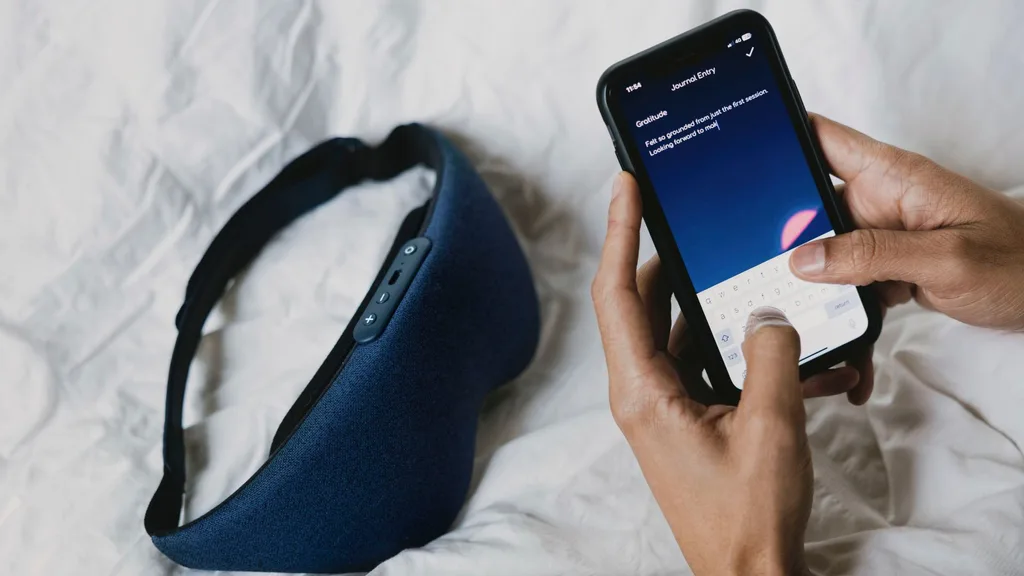
Lumenate started as an app paired with a phone’s torch — functional, but requiring users to hold their phone against their face or jerry-rig some kind of contraption, and potentially annoy their significant other or housemate. The Nova is the elegant solution: a soft eye mask with a built-in LED light bar that connects to the app via Bluetooth. Same stroboscopic technology and binaural soundscapes, and none of the phone balancing acrobatics.
My Experience With Lumenate Nova
The Nova is essentially an eye mask and an app. The mask connects to your phone via Bluetooth, and you can select different meditations based on your needs — sleep, waking up, disconnecting from work, creativity, erasing negative memories — broken into easy-to-navigate categories. Some have options ranging from five to 30 minutes so you can tailor them to how much time you have. The mask is an evolution of the original Lumenate technology which was a app paired with the torch on your iPhone. Functional but requiring users to jerry-rig a blacked out room or potentially annoy significant others or housemates on the couch. Jay and Tom’s intent was to make things accessible, and they have. While there are a lot of mentions of psychedelics in the marketing copy, the Nova is essentially a way to access deeper states of consciousness without years of practice, an expensive retreat, or the potential for getting arrested.
The Nova is quite a bit to get used to. The mask completely blacks out your vision and features a light bar in the centre. You select the meditation you want, plug in your headphones, and go. I personally like to burn a Tomato candle from Flamingo Estate when I meditate, but you don’t have to. The first experience of Lumenate is quite Black Mirror. As you stare into total darkness, an AI-sounding voice — which I later discover is actress Rosamund Pike of Gone Girl fame — comes on to sonorously instruct you to adjust your position for your comfort because “this is your time.” Then the strobe lights start. I found these very bright initially, but you can dial them down to suit your preference. Because of the way light moves through your eyelids, different colours drift across your vision – it is my time I think with satisfaction.
Did I find the experience of Nova psychedelic? I can’t speak to that in this forum, but it’s certainly easier to fit into your weekday than an eight-hour mushroom trip.
Did I find the experience of Nova psychedelic? I can’t speak to that in this forum, but it’s certainly easier to fit into your weekday than an eight-hour mushroom trip. Because you have binaural beats blasting in your ears, you can’t hear much, and you can’t see anything — this creates something like a sensory deprivation tank. I had a similar sensation to the moment when you’ve been lifted to the top of a rollercoaster and are waiting to drop, a kind of vertigo. If you find float tanks stressful, this isn’t for you. I didn’t have hallucinations during the experience, just lights, but I did emerge feeling refreshed and focused and wrote quite a lot on a project I’m trying to achieve more of with what Lumenate would term, better Work Life Separation” (yes, that is a soundtrack).
I can speak to Lumenate Nova’s immediate ability to shift your mental state. I found myself less tired and more focused after using “Deep Exploration” — my favourite meditation, full of swelling crescendos and throbbing pulses that move in time with the lights.
The sleep tracks will also knock you out as fast as six melatonin. If you’re an insomniac, these tracks justify the cost of the Nova on their own.
Not every meditation hit the mark for me, particularly the ones with more actively psychotherapeutic targets. One track called “Negative Thoughts” asks you to summon a negative thought you have about yourself, while Rosamund Pike advises you to think of it as a fossil, “a cold, hard and barren object.” It then asks you to offer the fossil some of your “kindness, gentleness and warmth” with the intent of challenging it.
This may be specific to me and the size of my fossils, but it turns out I need far more explicit direction from Rosamund than “breathing some of my kindness in” and imagining the thought-fossil bursting into a beautiful plant.
The exercise left me imagining my previously buried negative thoughts as terrifying vine plant-monsters from Jumanji. Rosamund, however, assures me I’ve “excavated something valuable” (the Jumanji board itself perhaps).
The result of the experiment was 15 minutes holding a negative thought in my head while ambient electronic music swelled and strobe lights flashed. It did vividly transport me back to having a panic attack in a Berlin nightclub in 2017, but I don’t think that’s the kind of astral projection the founders intended.
This is probably why the Lumenate app specifies a number of psychiatric and medical contraindications — if you’re managing chronic mental illness, this will not replace a medical team, and if you have a labyrinth of fossils to navigate, I’d suggest self-hypnosis tracks with more targeted instructions (Lacy Phillips’ To Be Magnetic recordings are excellent for extremely unruly inner children).
All of that said, this device is a 10/10 for night owls and has genuinely been an incredibly effective reset when I can’t motivate my ADHD-riddled brain to produce a single creative thought after a long day — all in between five and 30 minutes.
My inner child may still have some work to do. But at least she’s well rested.
The Lumenate Nova is available for $260.00 AU at Lumenate.
The post Can This Psychedelic Eye Mask Heal My Inner Child? appeared first on ELLE.