Views: 41
Hill’s of Kerrisdale, a historic boutique dating back to 1914, sits in a leafy well-to-do neighbourhood in Vancouver best known for its century homes and top private schools. Pass through the burnished-green exterior and you’ll find a mix of classic waxed Barbour jackets stocked alongside hip brands like Ganni and Agolde. On the surface, there’s nothing particularly unusual about this store, but it was here that a single rack of preppy blazers eventually morphed into the juggernaut retail empire now known as Aritzia. While most clothing brands are struggling to keep their doors open thanks to a slump in consumer spending and soaring U.S. tariffs, Aritzia has never been hotter. So, how did it go from being a single rack in a department store to one of the most successful fashion companies in the world? In the 1970s, Brian Hill spent summers working at Hill’s of Kerrisdale, the store owned by his dad, for as long as he could remember. The young Hill had a knack for dressing up and an instinctive sense of what people his age wanted to buy, which he parlayed into a section at the back of the store, called Aritzia, which would go on to sell Hard Candy nail polishes and hoodies by Triple 5 Soul before offering the in-house brands it is now known for. While the more-than-40-year-old brand has such universal appeal that it seems like it’s always existed, today, Aritzia could not be further from where it started out. In the past three years alone, the company’s growth trajectory seems to have been powered by rocket fuel. During the early months of 2021, sales had already jumped by 80 percent since the pandemic, and in the past year alone, U.S. revenue grew by 41 percent. The brand reported $66.3 million in net income in the second quarter of this year, rising from the $18.2 million netted in the same quarter last year—a 263-percent jump.
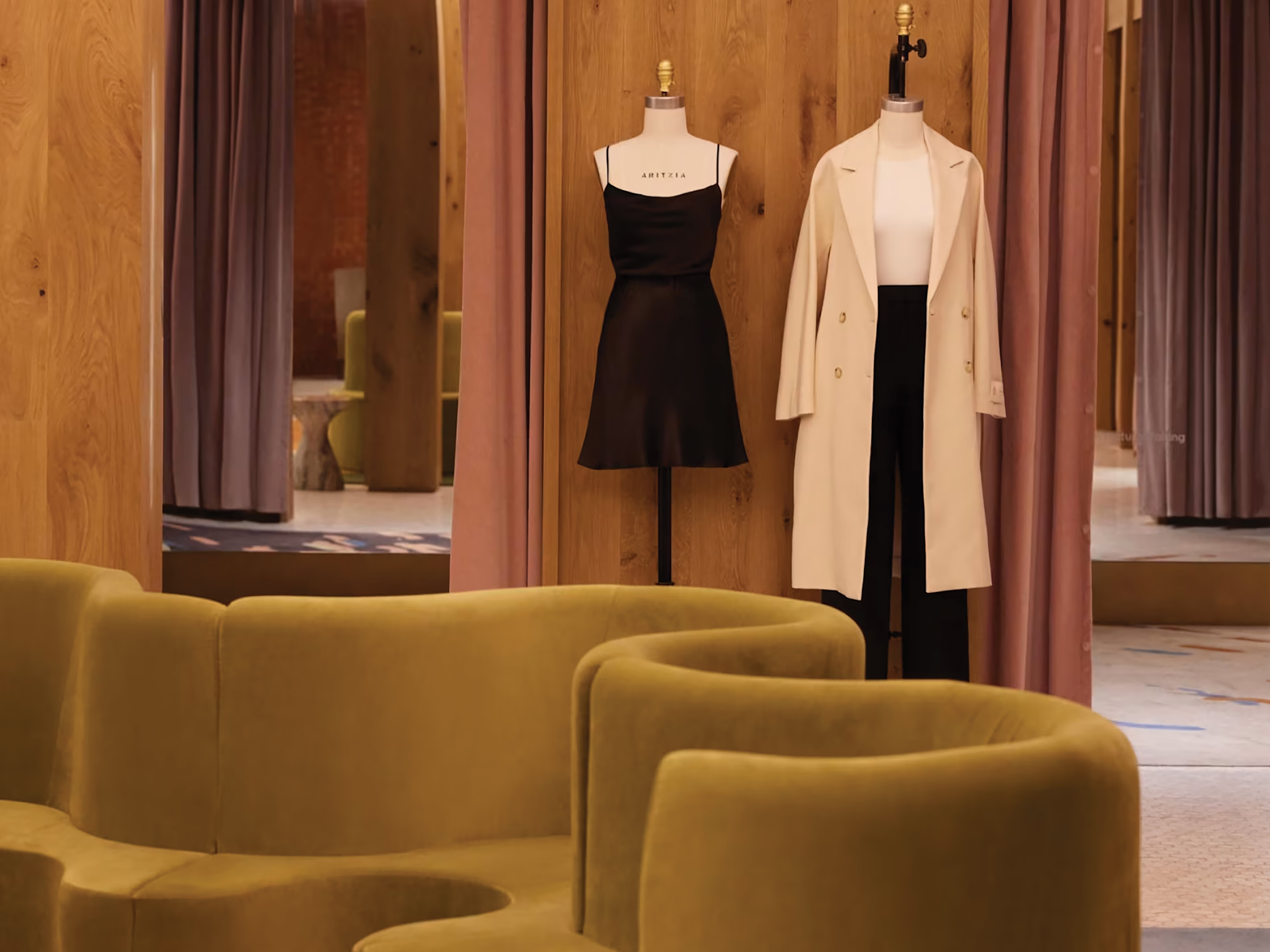
Photography courtesy of Aritzia
Almost every single woman in Canada has a piece of Aritzia in her closet. Maybe it’s leggings, a blazer or socks. If you’re a woman who has bought clothing at any point during the past two decades, there’s a good chance you’ve found yourself deliberating in front of one of Aritzia’s legendary communal mirrors or being tailed by one of its intimidatingly stylish (and hawkishly attentive) staff. In Canada, where the retail landscape is limited to widespread fast-fashion brands or high-end designers, with little in between, Aritzia’s simple selection of trendy basics feels less like a choice than a fact of life. The concept of everyday luxury has been woven into the wool-cashmere-blend fabric of Aritzia since its earliest days—today, it’s even trademarked. Hill, who declined to be interviewed for this article, told The Business of Fashion in 2009 that in the 1980s, he “saw a market opportunity, somewhere in between the luxury market and the junior market in women’s fashion, for young women who have significant disposable income but don’t want disposable clothes. These young women were seeking the experience of a boutique but didn’t really have access to it.” In other words, luxury you can buy at the mall. Hill knew from growing up as the son of a high-end-department-store scion that fancy boutiques offer their customers a better shopping experience—more visually appealing stores, higher-quality products, friendlier staff. But what if it was possible to replicate that experience and bring it to the masses? This made Aritzia an early proponent of “premiocre,” a category of consumer goods described by journalist Amanda Mull as “things you buy because they’re masquerading as more exceptional than they are.” The initial business model seemed to involve stocking stores with clothing made from high-quality fabrics and employing very stylish people to sell them, which proved both prescient and lucrative. By 1997, Aritzia had topped the sales per square metre for its category in every shopping centre it was in, according to a 2013 interview with radio station CKNW, and Hill realized that the brand was ready to go national. In 1999, the first stores opened up in Calgary and Toronto, where sales eventually outstripped Vancouver’s despite the city’s hometown advantage. [instagram-oembed url=”https://www.instagram.com/p/DQuP479krA4/?img_index=1″ /] By the early 2000s, Aritzia was well on its way to becoming the Starbucks of fashion: slightly upscale yet ubiquitous and with an ever-expanding menu of options. In the Eaton Centre alone, there are four separate stores under the Aritzia umbrella—including two located across from each other. Ask any Aritzia fan what they love about the clothes and they’ll say it’s the quality. “Most people have pieces that have been in their closet for at least five years,” says Katrina Lainsbury, a brand consultant and former Aritzia employee. “I still have and wear a cargo jacket I bought at Aritzia in 2009.” But what the brand truly excels at is creating simple garments that absorb seamlessly into anyone’s wardrobe. “It touches on trends, but what it’s really creating are staples,” she says. It’s the kind of store where a mother can take her teen daughter shopping and walk out having bought something for herself. Aritzia doesn’t rely on the Canadiana-steeped nostalgia of Roots or the faux-enlightened superiority of Lululemon. Most of the time, the selection seems intentionally bland. Yet the brand possesses the surprising ability to produce specific designs that become genuine cultural phenomena. In the 2000s, the uniform du jour among wealthy teen girls was a pair of TNA leggings, an Aritzia Cowichan-style sweater and a roomy TNA bowling bag. Now, it’s virtually impossible to walk a single block in downtown Toronto in winter without spotting several people in The Super Puff, the brand’s $300 Michelin Man-style down jacket. And last year, The Wall Street Journal ran a story on the runaway success of The Effortless Pant, titled “How $148 Aritzia Pants Took Over the Young Working Woman’s Closet.” These must-have items, seemingly indiscernible yet instantly recognizable, have attracted a massive fan base whose feverish devotion is best evidenced by the shockingly active Aritzia SubReddit, where more than 100,000 people congregate to regularly share outfit pics and salivate over the latest drops. Jila Shwani, a sustainability sales executive in Dallas, is one such superfan. She estimates that 80 percent of her wardrobe hails from Aritzia, and she has received gifts, including a bathrobe and a record player, for being a top client. “Shopping at Aritzia makes me feel rich,” she says. “Their stuff is really cute, and it’s obtainable. You can go in there and find a cute top that’s going to last you way longer than anything you buy at Shein.” There’s also the camaraderie. “The fitting room is like being drunk in a bar bathroom. Everyone is saying ‘That’s so cute’ and talking to one another.” [instagram-oembed url=”https://www.instagram.com/p/DSDe0Nakh1M/?img_index=1″ /] So, why such fervour over a basics brand? “I think women like it when stores are a little mean to them,” says Emily Keeler, a reformed Aritzia addict. Even though the store likely follows the same manufacturing methods as its mall neighbours, the clothes remain oddly aspirational. They paint a portrait of an Aritzia as the popular girl in your high school: friendly enough but always slightly out of reach. Keeler, now 38, started shopping at Aritzia in her early 20s, when she needed some simple office-appropriate work clothes. Then, when she became a yoga teacher, she found it was still the easiest place to find workoutwear. “It became the only place I would look and the first place I would look,” she says. Over time, she began to feel that the convenience of shopping at Aritzia was eroding her personal style. In 2024, she challenged herself to a one-year Aritzia shopping ban and hasn’t bought anything since, except for socks. “I ended up saving money and seriously thinking about what I wanted to bring into my closet instead of something just meeting the threshold of being good enough.” Only recent accusations of declining quality—lobbied by the rabidly devoted fan base of the Aritzia SubReddit—seem to be capable of turning former fans against the brand. And not everyone loves the communal fitting rooms and their adjacent “boyfriend couches” populated with bored significant others glued to their phones. Then there’s the sizing, which starts at XXS. While the range does go up to XXL, a search for “plus size” on the website tellingly yields no results. For a brand that markets itself as being universal, it manages to cultivate a distinct atmosphere of exclusivity. Over the years, Aritzia has weathered a number of criticisms, from anti-Black racism to allegations of Hill’s creepy behaviour to cutthroat working environments. But none of these controversies seem to have meaningfully tarnished the brand. By coating everything with a veneer of aspiration, Aritzia has managed to achieve the seemingly impossible: move like a fast-fashion brand without being perceived as one. In Aritzia’s fashion fairy tale, the popular girl gets her $7-billion happy ending. This article first appeared in FASHION’s Winter 2026 issue. Find out more here. Continue Reading