
Views: 39
Last year, The Cut published a viral story about the rise of the “Forever 35 facelift”, documenting the growing number of women in their forties opting for full surgical lifts. A facelift is, of course, the aggressive aesthetic procedure in which your face is lifted off your face and hiked around your ears before being stitched back into place. Historically associated with women in their fifties and sixties, the new logic is that younger skin heals better and therefore looks more “natural”. The rumour mill now speculates on patients ranging from Lindsay Lohan (39) to Kylie Jenner (28). The idea that I was rapidly approaching the age where sensible women start freezing themselves in time — much like we freeze our eggs — was unsettling.
While society is sympathetic to the biological clock, women in their thirties often find less understanding for the quieter panic around ageing. Dove ads from the 2010s were meant to address that, but the sense that our faces are ticking time bombs and that, at any moment, we’ll be compelled to spend tens of thousands on invasive procedures to avoid becoming a spectacle of decline has, for many of us, not faded.
I felt this acutely last year when I lost a dramatic amount of weight following a breakup. Faced with a particularly gaunt-looking “street style” photo of myself at fashion week, I adopted an affordable cheek-plumping strategy: a daily coconut Whittaker’s bar. It was both tasty and effective. Yet I knew the solution was neither sustainable nor permanent, and that glimpse of my future chilled me to my extremely vain core.
Related: I’m 24 And The TikTok ‘Aged’ Filter Has Me Worried About Ageing
So when I staggered into Olga Newman’s treatment room after a 40-degree January cover shoot, feeling like a paper bag someone had tried to steam back into shape, I arrived carrying both heatstroke and a mild mid-thirties crisis.
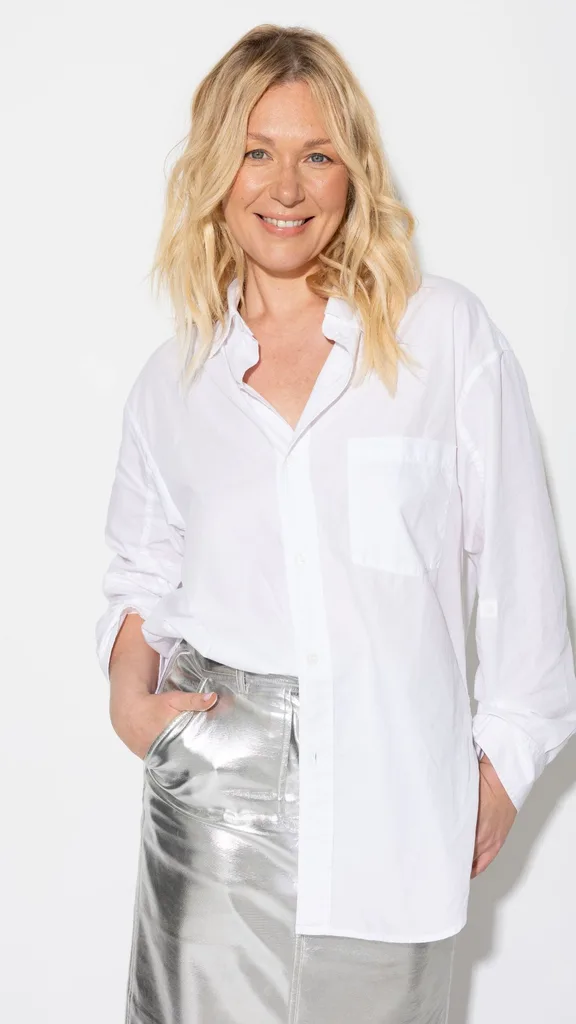
Newman greeted me with none of the incense-cloud mysticism I’d prepared for. Her “somatic facial” — famous online for its rhythmic slapping and pulling — had conjured images of bergamot vapours, sound bowls and emotional regression therapy. Instead, she has the brisk manner of someone who believes bodies are mechanical systems, not spiritual riddles, delivered in a Russian-inflected accent shaped by a childhood in spending time on her grandparents’ farm in Serbia. While she has Gwyneth Paltrow’s looks, she talks about the fascia and the connecting networks that cause our faces to change as we age with the seriousness of a structural engineer, probably because she once was one.
Despite the name, Face Up doesn’t really begin with the face. Olga starts at the feet and works upward, eventually arriving at the neck — the area she treats as a kind of command centre of ageing. She explains the fascia, a fine collagen web that wraps muscles, bones and organs, as the body’s internal scaffolding. When it’s supple, everything sits where it should; when it’s tight, tension travels, and features subtly descend. The zones with the quickest impact on the face are those surrounding it: the neck, upper back, ribcage, and shoulders.
“A simple example is the forehead,” she says. “People see lines and think age, then reach for injections. But forehead wrinkles usually have very little to do with ageing. They’re most often signs of tension along a fascial chain, commonly starting in the back of the neck and the occipital area.” And of course, in the brain. Our stress levels are projected onto our faces, not in a furrowed brow (which can be smoothed away by the right injector), but in a clenched jaw, which tightens the neck like a mask, literally dragging the rest of the face down.
The massage Newman has built a cult following for was closer to a sports massage than a therapeutic massage, almost totally dry. There’s a lot of pushing, pinching and pulling, but zero pain, and it’s medically notable that Olga is the first therapist to give me any kind of head and neck massage without immediately inducing a migraine.
Unlike a sports massage, it will leave you feeling euphoric.
At one point, Newman cupped her hands over my ears and rocked my head gently side to side. I briefly understood why babies stop crying when rocked in a carriage; memories of my sweaty, stressful day whisked away in an instant.
Like most facial massages, the immediate effects were brightness and light sculpting that improved over the following days. But the real shift was physical. I’d arrived at 5 am, awake levels of depletion; I left feeling structurally reorganised. Walking down the street afterwards, my head felt suspended by an invisible thread, my shoulders dropped somewhere closer to their original anatomical location, and I experienced a calm I didn’t recognise as belonging to my body.
I’m usually the first to tell friends that one facial won’t change your skin or your life. With most beauty practices, repetition is key. Newman agrees — which is why she created the Face Up app, essentially physiotherapy homework for your face and body. After the treatment, the absence of random aches is addictive enough that compliance comes naturally.
It feels like a rote part of a beauty review to say that since my treatment, my attitude to beauty has shifted. But I learnt more about how the body works and how the way I hold and use my body will impact my future face than I have in 10 years of working in the beauty industry.
It made me think of my grandmother, who practised yoga daily, used sorbolene her entire life, and died looking fifteen years younger than she was (something she’d be thrilled to hear).
If you put a frog in a pot, it won’t notice the water is starting to boil, and if you’re constantly aching and stressed, you won’t notice your face has all the smooth composure of a clenched fist. It took having the tension removed to realise just how much tension I was holding, and I now use the Face Up method a few times a week — a head-to-toe massage while watching a movie — to avoid getting to that point. The circulation and movement mean my skin stays bright enough, I find foundation unnecessary (so long as I’ve slept). And, its healthier than my Whittaker’s protocol.
Explore the Face Up Club App.
The post I Tried A ‘Fascia Facial’ Instead Of Saving For A Facelift And Have Zero Regrets appeared first on ELLE.