Views: 99
THE RUNDOWN
- The NOAA has issued a G2 (moderate) aurora australis alert for Friday, August 28, 2026.
- Experts advise that aurora enthusiasts in Tasmania and coastal Melbourne will have a chance of seeing the Southern Lights.
- Experts say that the full moon could compromise the view, and that aurora visibility will be based on hemispheric power (HP) that can be measured on a number of apps and websites.
It looks like some Australians could be in for a celestial treat tonight, with heightened geomagnetic activity triggering an aurora australis forecast across August 28 and 29.
Of all the celestial events we like to keep an eye on at ELLE, the aurora australis — otherwise known as the Southern Lights — is easily one of the most magnificent, lighting up the night sky in surreal washes of violet, emerald green and red.
Arun Chandran runs the popular Aurora Australis Facebook community, where hundreds of thousands of astronomy enthusiasts swap forecasts, photos and sightings. He says interest in the phenomenon is only growing. “Aurora chasing is incredibly addictive,” he tells ELLE Australia. “Those who’ve never seen one will chase every hint of activity and those who have seen one want to see more.”
The hunt has everything: the thrill of the chase, the FOMO and the kind of down-to-the-wire uncertainty that makes checking your phone every three minutes feel completely reasonable. An aurora, after all, is never guaranteed. “Most chasers would rather head out and see nothing than stay home and wake up the next morning to everyone else’s photos filling their feed.”
So, if you’re hoping to catch a glimpse of the Southern Lights, here’s everything you need to know.
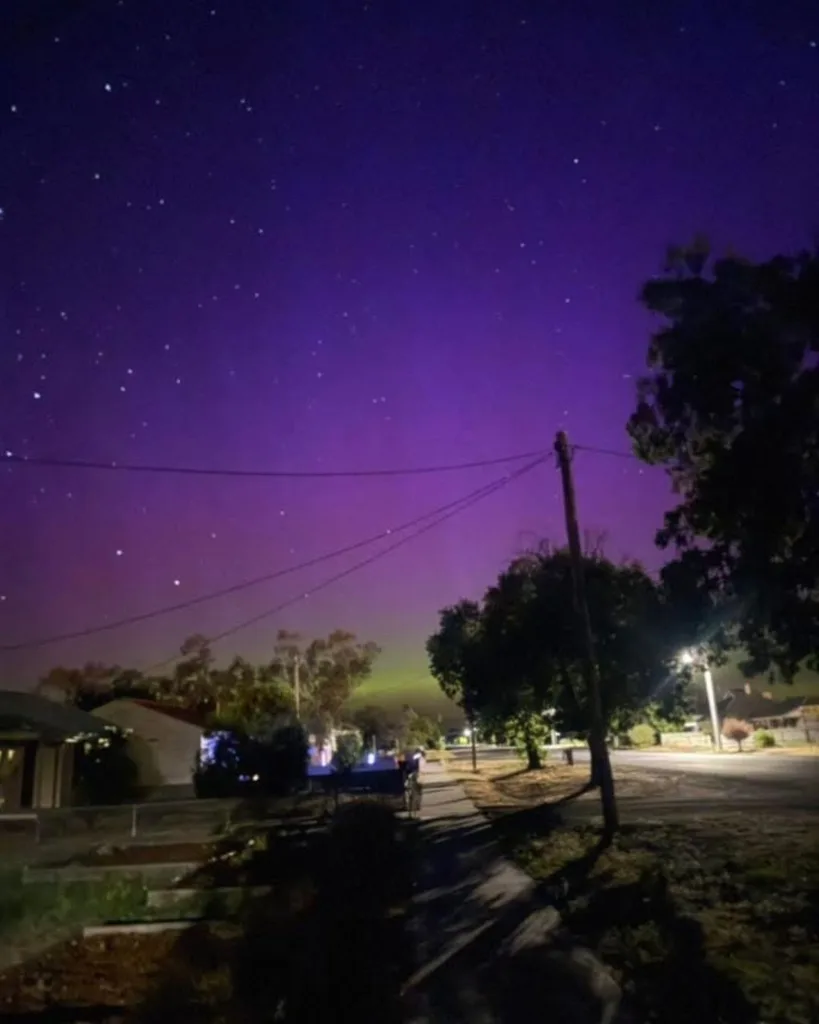
Where To See The Aurora Australis Tonight
There is currently some disagreement between international and Australian forecasts about exactly how strong the coming geomagnetic activity will be. NOAA’s Space Weather Prediction Centre has issued a G2, or moderate, geomagnetic storm watch for August 28 and 29, following several bursts of solar activity. Translation? Tasmania is currently the best bet, while southern and coastal Victoria could also be in play. But auroras have been known to surprise us.
On January 20, a rapidly moving coronal mass ejection that took only 24 hours to reach Earth triggered a surprise G4 (severe) geomagnetic storm. The resulting aurora was reported across Tasmania, Victoria, South Australia, New South Wales, Queensland and Western Australia and was photographed from suburban locations including Cronulla in Sydney and South Perth, with sightings reported as far north as Hamilton Island in Queensland. A good reminder of how quickly aurora conditions can change.
When To See The Aurora Australis Tonight
There isn’t a single magic hour when an aurora switches on. The actual display depends on what the solar wind and Earth’s magnetic field are doing in real time.
As a practical starting point, however, Chandran recommends waiting until roughly 60 to 75 minutes after sunset, when the sky is properly dark. From there, keep checking live aurora conditions: activity can intensify, fade and return throughout the night.
Use the table below to find the best time to start looking in your state. Sunset will also vary slightly depending on exactly where you are within each state or territory.
| State | Sunset | Time To Look |
| NSW (Sydney) | 5:34pm | 6:34-6:49pm |
| VIC (Melbourne) | 5:55pm | 6:55-7:10pm |
| QLD (Brisbane) | 5:32pm | 6:32-6:47pm |
| SA (Adelaide) | 5:53pm | 6:53-6:47pm |
| WA (Perth) | 5:57pm | 6:57-7:12pm |
| TAS (Hobart) | 5:40pm | 6:40-6:55 |
| ACT (Canberra) | 5:41pm | 6:41-6:56 |
| NT (Darwin) | 6:42pm | 7:42-7:57pm |
How To See The Aurora Australis
Unfortunately for hopeful aurora chasers, conditions aren’t ideal tonight thanks to the glow of the full moon. When lighting conditions are challenging, Chandran says a useful measure to watch is Hemispheric Power, or HP.
“Think of Hemispheric Power as the fuel gauge for the aurora machine in the sky – the total energy dumped in the earth’s upper atmosphere by charged particles. The more juice (HP) the bigger and brighter the light show.”
Hemispheric Power is measured in gigawatts (GW) and gives an indication of the total energy being deposited into the auroral region. Generally, a higher HP indicates a more energetic aurora; unfortunately, bright moonlight casts a floodlight washing out the vibrant colours of the aurora and making them hard to see and photograph.
“Depending on how moody and bright the moon is, you’ll need more HP to compete with its glare,” says Chandran.
Moon Fullness to Hemispheric Power Guide
0-30% Moon = 50 GW HP
30-50% Moon = 55 GW HP
60-70% Moon = 77 GW HP
70-80% Moon = 88 GW HP
80-90% Moon = 99 GW HP
90-100% Moon = 110 GW HP
Chandran says that with tonight’s bright moon, we’ll be looking for Hemispheric Power to move beyond around 110 GW before conditions become particularly promising.
You can monitor HP and the southern auroral oval through NOAA’s short-term Aurora Forecast, which updates using real-time solar-wind data as well as apps like SpaceWeatherLive.
The usual aurora rules also apply: head somewhere dark, get away from artificial light where possible, find an unobstructed view towards the southern horizon, and give your eyes time to adjust. Your phone camera may also detect colour that isn’t immediately obvious to the naked eye.
Is There An Aurora Australis Tonight?
If you’re in Australia, Friday, August 28 looks promising in some states. Tasmanians have the strongest odds under the present forecast, with southern and coastal Victoria also worth watching. Elsewhere, the chances become much slimmer unless the geomagnetic storm strengthens beyond current Australian predictions. But, as we’ve seen, sometimes we get lucky.
The post An Expert’s Guide To Seeing Tonight’s Aurora Australis In Your Australian State appeared first on ELLE.