Views: 103
“Before reading this, you didn’t know how to shop,” is the opening line of TikTok influencer turned author Andrea Cheong’s first book. Aptly titled Why Don’t I Have Anything to Wear?, it’s a chapter-by-chapter guide on how to change your relationship with your wardrobe and your shopping habits. A prayer to tackle the ultra-fast-fashion-fuelled dilemma: a closet full of clothes and nothing to wear. The paragraph ends: “It’s okay — it’s not your fault. I didn’t used to know how to shop either.”
The set-up could be the beginning of one of the videos that brought Cheong to social media fame — at the time of writing, she has 171,000 followers on Instagram and 257,300 on TikTok. Speaking to camera in a soft English accent, she delivers a well-balanced mix of shopping advice, critical garment analysis and mending tips interwoven with a dry wit. “The inner lining is a blend of textile and synthetic. Mmmm, sweaty, love that for us,” she says while reviewing a pair of H&M loafers. “No-one dislikes themselves enough for this.”
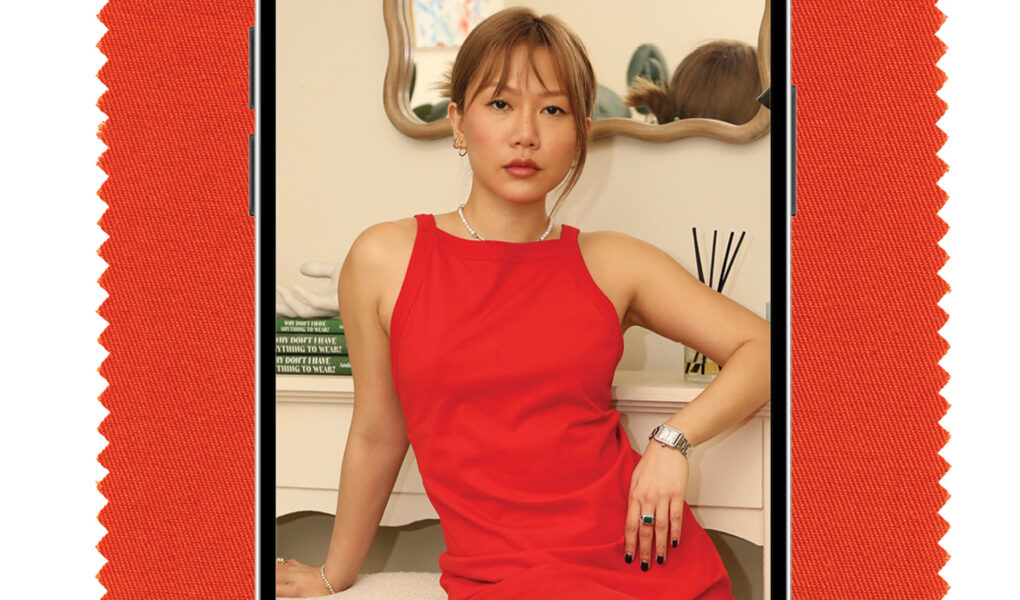
Although she shirks the label, at 34, Cheong is one of the most effective advocates for sustainable fashion of her generation. In addition to her online content and book, she created a podcast with luxury conglomerate Kering called Fashion Our Future and runs in-person sewing, knitting and mending workshops in London.
In an influencer landscape where relatability often trumps genuine expertise, if there is a secret to Cheong’s ability to master both, it might just be her rapid-fire, dead-pan delivery. Despite being self-taught, her knowledge of materials and garment construction is comprehensive and her explanations are thorough. Plus, she is so charismatic; she never asks the viewer to care, she never has to lecture. In doing so, she manages something that often eludes champions for ethical clothing: she applies the aloofness of Anna Wintour to the nerdiest parts of the fashion industry and the result is persuasive. Cheong’s club is one you want a membership to.
The first time I met Cheong was at the Global Fashion Summit in Copenhagen, a few months before her book was published in 2023. In person, she is exactly as she is on camera: perfectly groomed with glowing skin and the same nonchalant-but-funny quips. Although we’ve run into each other at various summits and events across London in the years since, it isn’t until we’re speaking on the phone for this article that I fully appreciate how, and why, she arrived at championing sustainable, well-made clothes.

As a child of the early 1990s, Cheong’s pathway from education to influencer was always going to be unconventional. Social media jobs were not yet a viable career choice when she was applying for university. Instead, she studied art history at University College London, worked in retail at Ralph Lauren and Abercrombie & Fitch, and tried her hand at trend forecasting. Eventually, she says, “I fell into doing mainstream fashion influencer stuff full-time.”
But the superficial pressures and the exposure, and the friction between influencers and legacy media, started to take a toll. “I was really unhappy and I can’t pretend it was all fashion’s fault [or] it’s all social media’s fault. It wasn’t,” she says. “I didn’t have a good sense of self. It was really bad for my mental health.”
It was in this watershed moment that her interest in sustainability was piqued. She began looking at why the fashion industry operates the way it does and experienced an epiphany: sustainability is intrinsic to quality. But she also discovered something else. “As I was learning about sustainability, I found that a lot of the mainstream content that I had access to was full of shame and guilt. And as someone who already felt that, it did not help,” she says. “I needed to find some sort of structure that I could use to shop better for myself but also be able to share that information in a more structured way because it can be so overwhelming. People get apathetic when they’re inundated with information.”
Out of this period of soul searching, the Mindful Monday Method was born. It’s a five-step process designed to break unhealthy shopping habits embedded in childhood, unlearn things pop culture has taught you and practise a new mode of shopping that benefits your wallet, mind and the planet. It was so successful, it carried her from TikTok videos all the way to a book deal.
The steps to the right of this article are about “getting to know your clothes very, very well”, she says. “Your clothes are your friends, and you should be able to speak to them.” This philosophy — an intimacy with your clothes — is at the heart of her mission, but after years of creating content and talking about it online, she realised it wasn’t quite enough.
“I’m showing people how to look at clothes, how to analyse quality and all of this stuff. But people are still saying to me, One, why is it so expensive? Two, where should I shop? Three, what can I do about the fast fashion I already have in my wardrobe?” she says. “And then I was like, Right. I guess I can teach them to sew.”
In launching The Sewn Assembly, a series of in-person workshops in London that cover everything from mindful mending and knitting for beginners to garment making and sip-and-stitch tutorials, Cheong has done something immensely powerful. By bringing her online audience together in the real world, where they are learning an almost-lost skill from the past, she has harnessed the good powers of the internet (finding community, entertainment, education) and used them to tame the dark powers (doom scrolling, isolation, screen addiction).
As the fashion industry’s emissions continue to increase, and production cycles grow faster and faster while quality declines, the power she’s giving back to consumers is invaluable. In Why Don’t I Have Anything To Wear?, she writes, “If you want to be cynical, we can call it redemption for my influencer days. I see it as my calling for this season of my life.”

Shopping 101
Lesson 1: Wardrobe Audit
Examine the clothes you already own. “The most important thing is that you are looking at the clothes you don’t want, not the clothes you do want — I’m not interested in that,” Cheong says. Take note of the common threads between them. What brands are popping up? What materials are on the care labels? Are there styles you think you like but then don’t end up wearing? “Try to find these patterns because that’s going to be the foundation of what you avoid going forward,” she says.
Lesson 2: Are You Emotionally Spending?
This step calls for exploration of your spending habits, relative to your mental health. It asks you to examine why you’re going shopping in the first place. “A lot of people shop for an identity that they aspire to. Some people do it as a hobby. It’s a relaxation thing; they’re looking for a dopamine hit. Some people are compulsive,” Cheong says. “It’s not that simply thinking about why you shop will stop you from doing it, but it can help with redirection. When you start to build that filter — of brands that don’t really serve you — it adds awareness. If I’m going to visit one of these stores, what am I there for really? It helps.”
Lesson 3: Fashion Goal Setting
Define your ultimate mission when shopping. Ask yourself: would you actually rather see the price of the garment in your bank account? Did the item need to be made? (A coat made of polyester won’t keep you warm, so it fails the test.) And if I’m not allowed to take any pictures in this, do I still want it? “Think about these clothes like you’re on a date. You walk in, you see the person and you’re like, Oh, he lied about his height. Okay, that’s not a deal breaker. Oh wait, he was rude to the waiter. I’m walking away,” she says. “You don’t owe that person anything. You also don’t owe that brand anything and you don’t have to buy from them.”
Lesson 4: Materials Matter
This is where Cheong’s expertise really comes alive. She advocates for garments made from high-quality natural fibres. “Check your care labels; no synthetic blends,” she says. Unless there is a very specific performance requirement — like the four-way stretch of elastane that’s necessary in swimwear — polyester, nylon and polyamide are almost always used to bring the cost of the garment down. Ultimately, in all her years of examining clothes, she’s found: “If a brand is going to compromise on their fabrics, they’re also going to compromise on how the garment is made.”
Lesson 5: Quality Control
Look for telltale signs a garment has been constructed with care. “Scan it for any immediate flaws. Are there snags? Is there a lot of pilling? Is it wonky? Are the buttons loose? And if you see any of that, just don’t even bother,” Cheong says. Also check that the item’s hardware — things like zips — is actually functional. If everything is in order, the next step is to turn the garment inside out and examine the seams for raw edges and loose stitches. “If it looks as good on the inside as it does on the outside, that’s a good indication,” she says.
The post Do You Need A Shopping Coach? appeared first on ELLE.