Views: 102
When I’m writing a story, sometimes another one emerges from over the horizon, not yet crystallised. It’s distracting sometimes, this hazy thing, asking to come into view. The sciura was one such glimmer. I was interviewing Anastasia Fedoseeva (@thestreetpie, 320k followers), a street style photographer based in Milan, where she spends her time documenting the sharpest dressers on the Italian fashion capital’s cobblestone vias. We discussed her takeaways from her time shooting the recent autumn/winter collections and she was dropping pearls of sartorial wisdom she’s picked up over her 14 years of shooting the Milanese. “Milanese men rarely wear black,” she told me. And hats? “It’s totally normal here.” Pillboxes, busboy styles, fedoras, you name it — and it’s gracing the crown of an Italian signor near you.
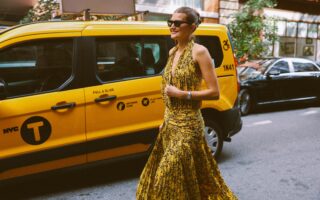
It was then that she started talking about a particular kind of impeccably dressed older woman, the kind I’d noticed on la passeggiata (the early evening walks that are a ritual for the Milanese, consummated by an aperitif and a handful of fat olives). With their high bouffants and click-clacking low heels, they were often tiny and sometimes doddering, but always unshakeably elegant. I would watch them sinking doppio espressos at laminate counters, scooping up flowers for the way home, sweeping long coats into the back of black cabs. “One of the most iconic Milan styles is [the] sciura,” Fedoseeva explained. “They are always very well-groomed — hair, manicure, makeup … You see a lot of brands like Prada and Gucci, small heels and classic coats in winter.”
I suppose it could be described as glamour, but without the obtrusiveness or the self-consciousness that word carries. Clothes are important, but trends? Much less so. “There are some very typical ‘Milan’ details, like friulanes — soft velvet slippers in many colours, very popular here — or Barbour jackets in mid-season. And they love accessories: not only rings and necklaces but a lot of earrings, often multiple piercings. It adds character even to simple looks.”

Character seems to be the defining quality of a sciura (pronounced shoora). Angelo, who goes only by his first name, has been documenting them for a decade. His Instagram account, @sciuraglam, which he started in 2016, now boasts more than 420,000 followers. According to him, a sciura is defined by “her kitten heels, big sprayed hair, pearls … and her attitude”. When he moved to Milan from his small home town in the south of Italy, he started noticing sciure (plural of sciura) around him: dressed to the nines, socialising, flitting about town. They reminded him of his late grandmother, who embodied grace and attitude. “Even if she could not wear such extravagant things,” he says, because of the incongruity in their small town, she was an avid collector of Saint Laurent bags, “and had some iconic Valentino shoes”.
In recent months, @sciuraglam has collaborated with a wave of brands. On Angelo’s page, sciure dine on terrazze alfresco, clinking spritzes for makeup brand Kiko Milano; they carry MyTheresa’s bright yellow shopping bags; they play padel in Golden Goose sneakers (and Louis Vuitton scarves, naturally). But the style transcends the fashion world’s rush to commodify it. Italian women have been embodying it, online and offline, for years. Giovanna Engelbert, the global creative director of Swarovski, is an austere beauty who drips in jewellery, her cat’s-eye sunglasses and high necklines giving her the impression of a Fellini heroine on her way to a board meeting. Take also the late stylist and photographer Manuela Pavesi, whose more-on-more approach cemented her as a fashion-set favourite. As Miuccia Prada’s right-hand woman, Pavesi was often photographed in the Miu Miu archives, blending texture on texture with some added bling and maybe a pair of gloves for good measure. There’s a subtle art to not looking ‘too much’, but the sciura walks the line with poise.
For an industry that pedestals youth to a fault, the sciura is a notable departure. So what’s the appeal?
“When we see them with their friends around the city, enjoying an aperitif or strolling around with luxury bags and shopping in the city centre, we want to age like them … we want to be like them, we want to have their life,” Angelo says. At a time when young people’s lives can feel restricted — financially or culturally, through the expectation that much of work and socialising are done through a screen — the sciure embody a bold physical presence that is so attractive. They’re out in the world, getting coffee, shopping up a storm and linking arms with their lovers (even when they’ve been married to them for 40 years). As the idea of anti-ageing continues to grow new heads like Hydra — five years ago it was retinol and vampire facials; now, it’s surgical facelifts in your forties — the option of ageing with style, grace and a not-insignificant level of pizzazz is what many of us are seeking. The sciura gives us an alternative: a lined face, an impeccable wardrobe, a life of eating and drinking with gusto. One that doesn’t count itself out of pleasure, beauty and joy — and, of course, shopping — because of age. It’s “aspirational”, Angelo says.
While there is some consensus over what a sciura wears, where she shops and how she presents to the world, her subtler qualities are harder to pin down. “They taught me that no matter what you wear, it’s the person who wears it that makes a piece of clothing or the shoes elegant,” Angelo says. That’s something Fedoseeva has noticed in her time taking their pictures. Yes, the sciura is about hats and bold gold (preferably all at once), but also something quieter, she says: “Personality, quality and small details … and not trying too hard.”
The post Meet The Sciura: Fashion’s Newest Style Obsession appeared first on ELLE.